transpolia (fragments re-set)

I asked him ⋮ to dance more.

I asked him once:

“How does it feel to be called a loghotékhnis?”
[Greek akin to “wordsmith” or “litterateur.”]

His answer:

“These two words
lóghos and tékhni
[‘the word’ and ‘art’]
stuck together leave me uneasy.
I prefer the lightness of the word
kímeno [‘text’]…

“There aren’t any nice [Greek] words
to describe those who write.
Senariográfos [‘screenwriter’] isn’t nice.
Syngraféas [‘author’] isn’t nice either.

“Isn’t it tragic? To write,
but for the words
that describe what you do
to be horrible?

“Whereas khoreftís, for example,
now that’s a lovely word
to describe those who dance
– simple, with a nice ring to it,
it’s a word that only makes them
want to dance more.”
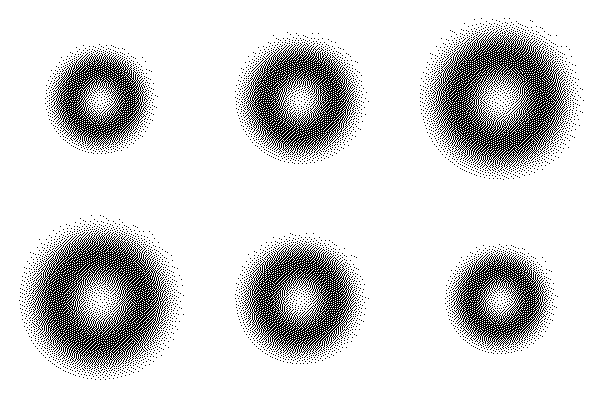
A pulsing luminous donut shape made of a many moving particles

Efthimis Filippou answers a question posed by Julia Tsiakiris

Μια φορά που τον είχα ρωτήσει «Πώς σου φαίνεται αν σε αποκαλούν λογοτέχνη;» αποκρίθηκε:

«Αυτά τα λόγος και τέχνη κολλημένα μου προκαλούν δυσφορία. Μου αρέσει πιο πολύ η ελαφρότητα της λέξης κείμενο… «Δεν υπάρχουν ωραίες λέξεις γι’ αυτούς που γράφουν. Ούτε το σεναριογράφος είναι ωραίο ούτε το συγγραφέας. Δεν είναι τραγικό να γράφεις και οι λέξεις που περιγράφουν την ιδιότητά σου να είναι άσχημες; Ενώ για παράδειγμα το χορευτής είναι μια ωραία λέξη γι’ αυτούς που χορεύουν, εύηχη, απλή τους κάνει να θέλουν να χορέψουν κι άλλο».

Anecdote taken from an oral introduction to the work of Efthimis Filippou given by Julia Tsiakiris at the presentation of the Noon book collection, held at Hyper Hypo in Athens on 27 February 2025.

For Julia’s thoughts in full, see the dubitandum “coldness ⋮ complexity” (in the yellow boxes below).

Translated for the love of it.
 

see also
Noon ⋮ lies ahead.
This here ⋮ (from Brazil.)
 

arkhæio
NOON
 
dubitanda
coldness ⋮ complexity constantly ⋮ faithful documents ⋮ inaccurate