Ghost boy ⋮ killer.

Ghost boy bops on the dance floor
In among just girls
Who want boys who once were girls
Who wanted boys and wanted girls
Who are not boys and nor are girls
Dancing solo to drive the drowsy away
Slipping guns into belts as they bop
Life’s a killer

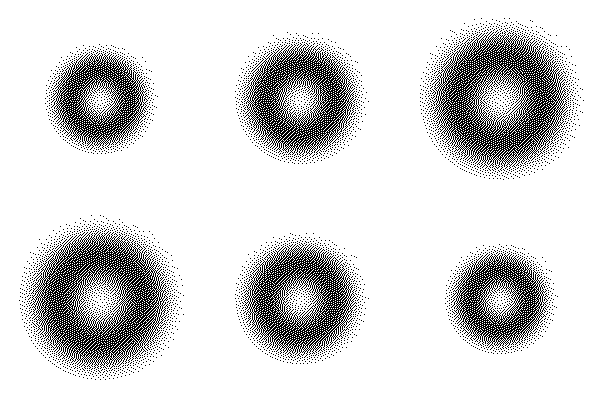
A pulsing luminous donut shape made of a many moving particles

Pan Pan, taken from his song “Jolt Me Like a Bolt on the Dance Floor” (2021)

Φάντασμα αγόρι χορεύει στην πίστα
Ανάμεσα σε μόνο κορίτσια
Που θέλουν αγόρια
Που ήταν κορίτσια
Που θέλαν αγόρια
Και θέλαν κορίτσια
Που δεν είναι αγόρια
Και ούτε κορίτσια
Χορεύουνε μόνα να φύγει η νύστα
Χορεύουν και βάζουν το όπλο στη ζώνη
Ζωή που σκοτώνει

Translated for (and taken from) the essay “Our Army of Lovers” by Mare Spanoudaki that appeared in Issue One (“The Cultural and Political Memory of HIV”) of Octopus, the EMST magazine.
 

see also
But rejection ⋮ at night.
It is ⋮ everything .
 

arkhæio
HIV MEMORY
 
dubitanda
before ⋮ death emotive ⋮ realm
But rejection ⋮ at night.

But rejection knows
There is no villain
Just the hand
That turns the light out at night

A pulsing luminous donut shape made of a many moving particles

Kore. Ydro., taken from their song “Handshake / Gay Anthem for the New Millennium” (2006)

Μα η απόρριψη το ξέρει
Πως δεν υπάρχει κακός
Υπάρχει μόνο ένα χέρι
Που μας σβήνει τη νύχτα το φως

Translated for (and taken from) the essay “Our Army of Lovers” by Mare Spanoudaki that appeared in Issue One (“The Cultural and Political Memory of HIV”) of Octopus, the EMST magazine.
 

see also
Ghost boy ⋮ killer.
It is ⋮ everything .
 

arkhæio
HIV MEMORY
 
dubitanda
before ⋮ death emotive ⋮ realm

It is ⋮ everything.

It is that thing whose first experience you fear.
A thing too hard to handle. A thing too hard to face.
It is that thing that when you finally give in
becomes a life essential that changes everything.

A pulsing luminous donut shape made of a many moving particles

Yorgos Marinos, taken from his song “Sex” (1984)

Κι είναι εκείνο που φοβάσαι να γνωρίσεις
Να το κουλαντρίσεις και να τ’ αντιμετωπίσεις
Είναι αυτό που όταν ξέρεις να το ζήσεις
Γίνεται ουσία και σου αλλάζει τη ζωή

Translated for (and taken from) the essay “Our Army of Lovers” by Mare Spanoudaki that appeared in Issue One (“The Cultural and Political Memory of HIV”) of Octopus, the EMST magazine.
 

see also
But rejection ⋮ at night.
Ghost boy ⋮ killer.
 

arkhæio
HIV MEMORY
 
dubitanda
before ⋮ death emotive ⋮ realm

I am ⋮ weeping.

I am one who knows that the new
shall meet the old amid much weeping

A pulsing luminous donut shape made of a many moving particles

Nikos A. Panagiotopoulos, from his long-form poem Syssimon (The Sign Agreed Upon)

Είμαι άνθρωπος που ξέρει πως τα καινούργια
θα βρούνε τα παλιά μέσα στα κλάματα

Translated for (and taken from) a text by the director Michail Marmarinos describing his MYSTERY 0, the opening ceremony of 2023 Eleusis European Capital of Culture.

This text was written for the event catalogue Mysteries of Transition.
 

see also
A mutilated ⋮ death.
 

arkhæio
MYSTERIES OF TRANSITION

The catharsis ⋮ of proportion.

…the catharsis of Greek tragedy is, in essence,
nothing more than a matter of proportion

A pulsing luminous donut shape made of a many moving particles

Yorgos Himonas, from the introduction
to his 1989 version of Euripides’ Medea

…ἡ Κάθαρση στὴν τραγωδία δὲν είναι, στὴν ουσία,
παρὰ ἕνα ζήτημα ἀναλογίας

Yorgos Himonas (1938–2000) was a psychiatrist, translator, and writer.

Translated for and taken from the 2008 printed programme created for the stage work Medea(2) by Dimitris Papaioannou.

In the book, this fragment is set alongside a wide-shot of Nikos Alexiou’s revived set design installed inside an industrial space. The words elucidate his work.
 

see also
Betrayal comes from ⋮ another.
Today ⋮ forever more.
 

arkhæio
MEDEA (TO THE POWER OF) TWO MEDEA MANUAL A (FOR ATHENS)
 
dubitanda
enters ⋮ darkness fundamental ⋮ measure

Today ⋮ forever more.

Today is the final day.
Soon there will be night and only night
forever more.

A pulsing luminous donut shape made of a many moving particles

Yorgos Himonas, words spoken by Medea,
from his 1989 version of the Euripides play

Αὐτὴ εἶναι ἡ τελευταία μέρα.
Θὰ νυχτώσει καὶ θὰ εἶναι πιὰ
γιὰ πάντα νύχτα.

Translated for and taken from the 2008 printed programme created for the stage work Medea(2) by Dimitris Papaioannou.

In this piece, at its end, a triumphant, bare-chested Medea swings and smashes a dangling bulb over Jason’s head, plunging him (and the audience) into darkness.

Himonas beautifully conjured this line from his own imagination – nothing like it appears in the original Ancient Greek text by Euripides (dating to 431 BCE).
 

see also
Betrayal comes from ⋮ another.
The catharsis ⋮ of proportion.
 

arkhæio
MEDEA (TO THE POWER OF) TWO MEDEA MANUAL A (FOR ATHENS)
 
dubitanda
enters ⋮ darkness fundamental ⋮ measure

Are you afraid ⋮ comrade.

Are you afraid of life becoming homosexual?
And I don’t mean just sticking it
in and out and out and in again
I’m talking tenderness, comrade

A pulsing luminous donut shape made of a many moving particles

Pedro Lemebel, from his manifesto “Hablo por mi diferencia” (“I Speak for My Difference” – 1986)

¿Tiene miedo que se homosexualice la vida?
Y no hablo de meterlo y sacarlo
Y sacarlo y meterlo solamente
Hablo de ternura compañero

Φοβάσαι μήπως γίνει η ζωή ομοφυλόφιλη;
Και δεν μιλάω για το να το βάζεις και να το βγάζεις
Και μόνο να το βγάζεις και να το βάζεις
Μιλάω για την τρυφερότητα σύντροφε

Taken from the essay titled “Are You Afraid of Life Becoming Homosexual?” written by Nionia Films for the Thessaloniki Documentary Festival publication Citizen Queer.

Greek translation from the Spanish by Nionia Films.
 

see also
this transpolium lives alone
 

arkhæio
CITIZEN QUEER

A mutilated ⋮ death.

A mutilated horse watches intently for the arrival
Of processions that shall not come again.
Others shall come instead, men in white coats
Engineers, workers, indifferent to these mysteries.
And at the fixed hour, the factories blazon
The arrival: a procession of shadows and secrets
Lost in the eyes of a horse
Holding vigil over its own death.

A pulsing luminous donut shape made of a many moving particles

Jacques Lacarrière, untitled poem written after a visit to Elefsina (ancient Eleusis)

Un cheval mutilé guette l’arrivée
De cortèges qui ne reviendront plus.
D’autres viendront, hommes en blouse blanche
Ingénieurs, ouvriers, indifférents à ces mystères.
Et les usines crieront à heure fixe
L’arrivée du cortège des ombres et des secrets
Perdus dans les yeux d’un cheval
Veillant sa propre mort.

Ένα ακρωτηριασμένο άλογο παραφυλάει την άφιξη
πομπών που πια δε θα ξανάρθουν.
Άλλοι θα ‘ρθουν ντυμένοι μ’ άσπρες μπλούζες,
Μηχανικοί, εργάτες, αδιάφοροι για τούτα τα μυστήρια.
Και τα εργοστάσια να ξεφωνίζουν την ίδια ώρα πάντα κάθε βράδυ
την άφιξη της πομπής των σκιών
Και τα μυστικά τα χαμένα στα μάτια ενός αλόγου
που ξενυχτάει τον ίδιο του τον θάνατο.

This poem was published in an afterword to Jacques Lacarrière’s 1993 book L’été grec (Greek Summer).

Translated for (and taken from) the essay titled “PANIGÍRI: Live Cinema – The Working Class – Sirens” written by Syllas Tzoumerkas for the Thessaloniki Documentary Festival publication On the Threshold (TiDF25).

PANIGÍRI was a live cinema festival curated by Syllas Tzoumerkas for the Mysteries of Transition programme (2023 Eleusis European Capital of Culture – MYSTERY 84).

For the original French, see: Jacques Lacarrière, “Postface. Retours en Grèce 1976-1982: Carte d’identité grecque,” in L’été grec: Une Grèce quotidienne de 4000 ans (Paris: Plon 1993 [1975]), 426–432.

For the Greek translation from the French by Haris Papadopoulos, see: Jacques Lacarrière, Erotikó Lexikó tis Elládas (Athens: Hatzinikoli 2007).
 

see also
All that I ⋮ back.
I am ⋮ weeping.
Like ⋮ the smell of earth.
Rose-like ⋮ all the flowers.
Words ⋮ seem unrecognisable.
 

arkhæio
MYSTERIES OF TRANSITION ON THE THRESHOLD

Like ⋮ the smell of earth.

…Like a plank off some sorry wreck,
so drifts our Old World

…Sure, it once loved
the ideals of humankind,
but the birds
were flying off ahead

Harsh, heartless world
that never once opened an umbrella
over the tree being drenched

But at night, how lovely it is,
the smell of earth…

A pulsing luminous donut shape made of a many moving particles

Tasos Leivaditis, from the poem “Nighttime Redolence”
in the 1990 collection Autumntime Manuscripts
(published two years after his death)

…Σὰ σανίδα ἀπὸ θλιβερὸ ναυάγιο
ταξιδεύει ἡ γηραιά μας ἤπειρος

…Βέβαια ἀγάπησε
τὰ ἰδανικά της ἀνθρωπότητας,
ἀλλὰ τὰ πουλιὰ
πετοῦσαν πιὸ πέρα

Σκληρός, ἄκαρδος κόσμος,
ποῦ δὲν ἄνοιξε ποτὲ μίαν ὀμπρέλα
πάνω ἀπ᾿ τὸ δέντρο ποὺ βρέχεται

Ἀλλὰ τὰ βράδια τί ὄμορφα
ποῦ μυρίζει ἡ γῆ…

This Tasos Leivaditis poem was also set to music by Yorgos Tsangaris to create the 1993 song “But at Night…” sung by Vassilis Papakonstantinou and narrated by Yorgos Michalakopoulos.

Translated for (and taken from) the essay titled “I Am Nature (Who’s There?)” written by Thouli Misirloglou for the Thessaloniki Documentary Festival publication On the Threshold (TiDF25).
 

see also
A mutilated ⋮ death.
All that I ⋮ back.
Rose-like ⋮ all the flowers.
Words ⋮ seem unrecognisable.
 

arkhæio
ON THE THRESHOLD

An all-round driver of ⋮ systems.

an all-round driver of relationships (all kinds)
– both out in nature and within cultures –
that destabilises all biological and social systems

A pulsing luminous donut shape made of a many moving particles

description of a parasite in the mode of Michel Serres

ένας γενικός τελεστής σε κάθε μορφή σχέσης,
τόσο εντός της φύσης όσο και εντός του πολιτισμού,
που αποσταθεροποιεί όλα τα βιολογικά και κοινωνικά συστήματα

Quote translated from the Greek and taken from the back cover of the following book: Michel Serres, To Parásito [The Parasite], translated from the French by Nikos Iliadis and edited by Dionysios Kavvathas (Athens: Smili Publications, 2009).

Taken from the essay titled “Of Monsters and Men” written by Geli Mademli for the Thessaloniki International Film Festival publication We, the Monster.
 

see also
(this transpolium lives alone)
 

arkhæio
WE, THE MONSTER